






Indication for planned caesarean section is performed by a gynaecologist, most often at registration at the 36th week of pregnancy.
A planned caesarean section is performed after the 39th week of pregnancy, unless there is a reason to perform it earlier.
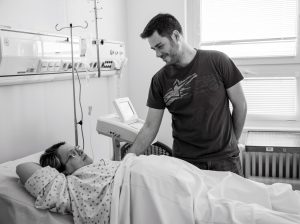
The day before the surgery, the woman comes to the hospital with the results of the pre-operative examination. She is admitted to the bed in the Puerperium and Pregnancy-in-risk Department. She has been fasting since midnight and in the morning of the surgery she is given an enema, the department PA gives her flexilla and transfers her to the delivery room to prepare for surgery. A birth attendant may be present for this preparation. In the delivery room, the midwife will record a ctg monitor, bandage (elastic bandages) the lower limbs and insert a permanent urinary catheter into the bladder.
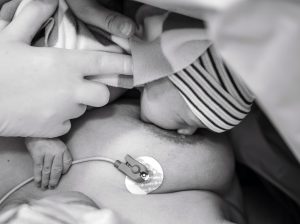
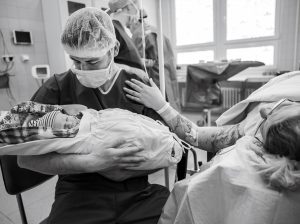
The planned caesarean section is performed, after consultation with the anaesthesiologist, under spinal anaesthesia, which is more convenient for both the woman and the baby. The presence of an attendant in the surgery room is a matter of course. After the baby is born, a delayed umbilical cord ligation is performed. The umbilical cord can be cut by an attendant, after consultation with the surgeon. Then the paediatrician performs the first treatment and examination (breathing, heart action...) of the baby and if the postpartum adaptation is without complications, the baby is placed on the woman's chest. Bonding can also be performed by an attendant if the woman cannot for some reason. The baby is with the parents in the operating room throughout the operation and after the operation is over, everyone is transferred to the post-operative room of the six-week ward. Here again bonding is encouraged with the mother or father of the baby. The baby is permanently with the woman and in the first hours, days the neonatal nurses help her with the care of the baby.
If the woman and baby are well, they are discharged 3-4 days after the surgery.